Turnkey Solutions
From Your Production Target to First Heat on Your Floor
You tell us what you need to pour and where. We size the plant, draw the layout, specify the transformer and cooling, build the equipment, test it on load, pack it for sea freight, and send our engineers to install, commission and train — with one named engineer accountable across all of it.
What a Turnkey Scope Includes
Stated as a line-by-line scope of supply in the quotation, so there is no argument later about what was and was not included.
Supplied by us
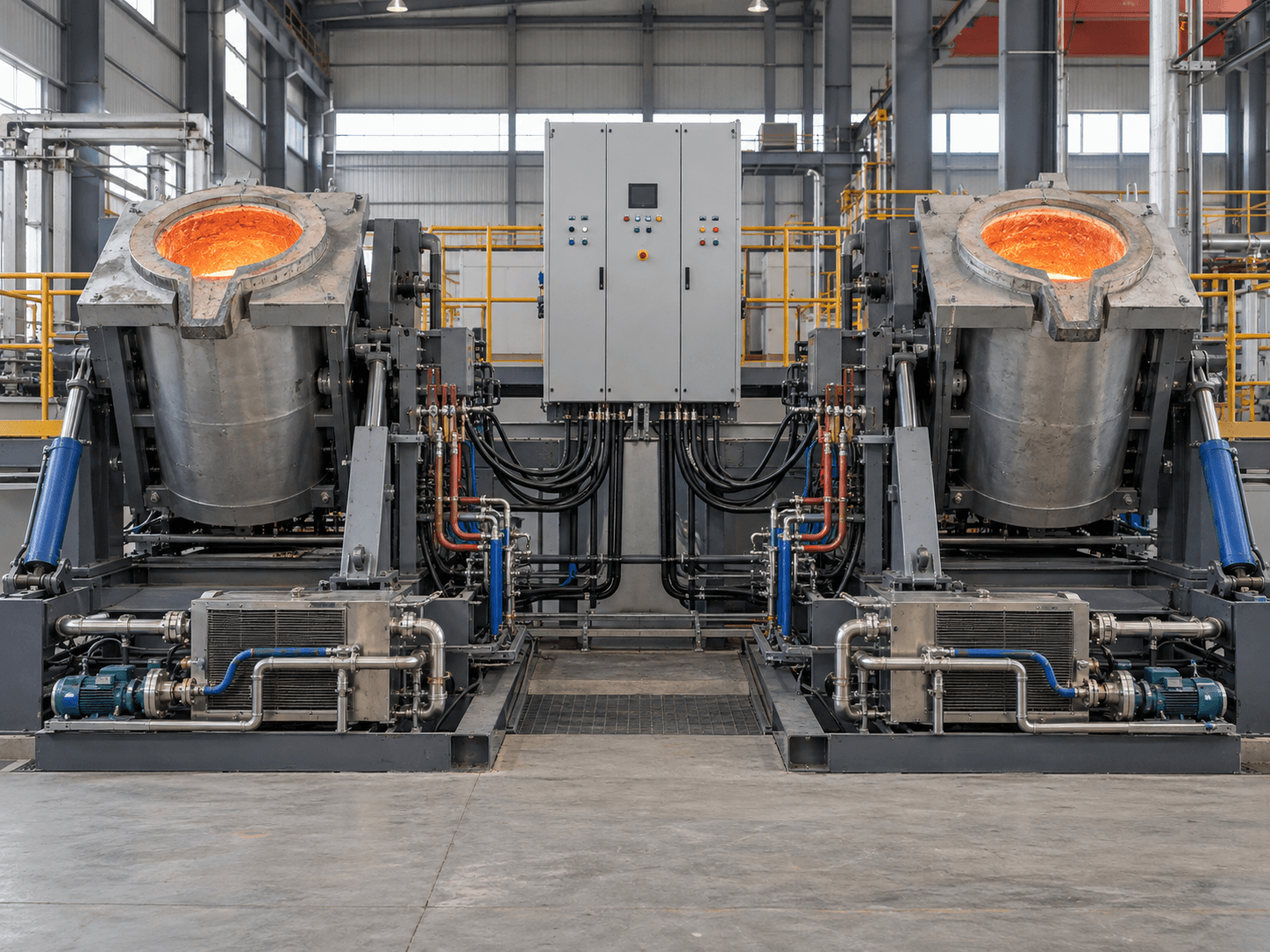
- Furnace body, coil, yokes and hydraulic tilting station
- Medium frequency power supply and capacitor cabinet
- Water-cooled cables, busbar and interconnection
- Closed-loop cooling system and cooling tower
- Operator console, control system and English HMI
- Refractory for the first two linings, formers and ramming tools
- Plant layout, foundation, transformer and cable schedules
- Two-year recommended spares kit, priced separately and clearly
- Installation supervision, commissioning and training on site
By the customer
- Civil works to our foundation drawing, and the melting pit
- Incoming substation, transformer and supply cable to our schedule
- Raw water supply and drainage to the cooling system
- Crane or lifting capacity for installation and charging
- Import clearance, duties and inland transport (unless DDP)
- Charge material and consumables for commissioning trials
- Local electrical and mechanical labour under our supervision
Any of the customer-side items can be brought into our scope on request — we would rather quote it explicitly than leave a gap that surfaces when the containers are already at the port.
The Six-Step Project Process
Typical total timeline is 3–5 months from technical brief to first heat, of which manufacturing is 45–80 days and site preparation usually determines the critical path.
- 01
Technical brief
We collect your alloy, target output per hour, working hours per day, grid voltage and frequency, and available floor space. Nothing is quoted until those six answers are on paper.
- 02
System design & layout
Our engineers return a furnace capacity and power recommendation, a plant layout drawing, a transformer and cable schedule and a cooling-water heat balance — normally within 3 working days.
- 03
Quotation & scope of supply
A line-by-line scope: what is included, what is by others, what the two-year spares kit costs. Payment terms, Incoterms and delivery are fixed at this stage, not negotiated later.
- 04
Manufacturing & factory test
Build progress is reported with photographs at defined milestones. Before shipment the complete system is assembled and run on load in our own works, and you or your inspector are welcome to attend.
- 05
Export packing & shipping
Seaworthy packing with fumigated timber, moisture barriers and desiccant. We handle the container plan, export declaration, certificate of origin and full document set for your customs clearance.
- 06
Installation, commissioning & training
Our engineers travel to your site to supervise installation, install and sinter the first lining, commission the system on your own charge material and train your operators and maintenance team.
In-House Capability
The mechanical package, the electrical package and the commissioning team are all ours. When a furnace does not behave the way the specification said it would, there is nobody to point at.
20,000 m² plant with 50+ senior engineers
160 staff, of whom more than fifty are senior engineers, working across a 20,000 m² manufacturing facility in the Weifang Economic Development Zone. Design, fabrication, assembly and load testing all happen on the same site.
In-house furnace body and coil manufacturing
Steel fabrication, coil winding from oxygen-free rectangular copper tube, yoke assembly and hydraulic system build — all in our own works, so the mechanical package is accountable to one team.
Power supply design and assembly
KGPS thyristor and IGBT series-resonance inverters designed, assembled and load-tested in-house, built to the destination grid voltage and frequency rather than adapted on site.
Full-load factory acceptance testing
Every system is assembled and run on load before it is dismantled for shipment. A witnessed factory acceptance test can be arranged for the customer or a third-party inspector.
Overseas installation and commissioning
Our engineers travel to site for installation supervision, first lining installation and sintering, commissioning on your own charge, and operator and maintenance training.
Export Commitments
Six things written into every export contract, because they are the six things overseas buyers have been let down on before.
Built to your grid
Voltage and frequency are specified at order — 380 V/50 Hz, 400 V/50 Hz, 415 V/50 Hz, 440 V/60 Hz or 480 V/60 Hz — with the matching rectifier transformer where required. No on-site improvisation.
Full-load test before shipment
The complete system is assembled and run on load in our works. You receive the test report, and you or your appointed inspector are welcome to witness it.
Seaworthy export packing
Fumigated timber crating with moisture barriers and desiccant, a container loading plan, and the complete document set: invoice, packing list, bill of lading, certificate of origin and insurance.
Installation and commissioning on site
Our engineers travel to your plant, supervise installation, install and sinter the first lining, commission on your own charge material and stay until the plant produces to specification.
Operator and maintenance training
Charging practice, melting procedure, lining monitoring, routine maintenance and fault diagnosis, delivered on your equipment with an English manual your team keeps.
Spare parts for the life of the machine
A two-year spares kit is priced in the original quotation, and every part is cross-referenced to your machine serial number so a later order is a part number, not a photograph.
What to Send Us
A meaningful quotation needs six answers. Send these and you will get a capacity recommendation, a plant layout, a heat balance and a line-by-line quotation — normally within three working days. Send less and any supplier who quotes anyway is quoting a catalogue item and hoping it fits.
- Alloy and tapping temperature — or the part and target temperature for a heating line
- Required output per hour, and working hours per day
- Grid voltage and frequency, and available transformer capacity
- Available floor area, ceiling height and crane capacity
- Destination port and preferred Incoterm
- Whether CE marking or a national approval is required
Typical Timeline
- Technical brief → proposal
- 2 – 3 working days
- Proposal → contract
- Depends on your approval process
- Contract → manufacturing complete
- 30 – 120 days by equipment type
- Factory acceptance test
- 3 – 5 days, witnessed if you wish
- Shipping (sea freight)
- 15 – 45 days by destination
- Installation → first heat
- 2 – 8 weeks, site preparation dependent
Site preparation — foundation, transformer and water supply — is the single most common cause of delay between container arrival and first heat. The relevant drawings are issued immediately after order so your civil and electrical work runs in parallel with our manufacturing.
Installation & Power Supply FAQ
- Will the equipment work on my country's voltage and frequency?
- Yes — it is built to your grid, not adapted on arrival. Specify 380 V/50 Hz, 400 V/50 Hz, 415 V/50 Hz, 440 V/60 Hz or 480 V/60 Hz at order, and we build the rectifier and control system to match. Medium-voltage units above roughly 3,000 kW are supplied with the matching rectifier transformer. Tell us the grid details in your first enquiry so the quotation is correct from the start.
- What transformer and incoming supply do I need?
- We issue a transformer and cable schedule with the quotation, sized to the furnace rating with the correct margin, including recommended cable cross-sections, protection settings and the earthing arrangement. For a 1,000 kW furnace, plan on roughly a 1,250 kVA transformer. Your local electrical contractor works to our schedule; we do not supply the incoming substation itself.
- What foundation and building do I need to prepare?
- A foundation drawing with loads, bolt positions and pit dimensions is issued after order so your civil work runs in parallel with manufacturing. You also need a cooling water position, a cable route from the transformer, adequate ceiling height for charging, and a drainage plan for the melting pit. All of it is on the layout drawing.
- Do you send engineers to install and commission the equipment?
- Yes. Our engineers travel to your site to supervise installation, install and sinter the first furnace lining, commission the system on your own charge material, and train your operators and maintenance staff. Duration is typically 10–20 days depending on the plant. Travel, visa, accommodation and daily allowance arrangements are set out in the quotation so there is no surprise afterwards.
- How long does installation take once the equipment arrives?
- For a single melting furnace, typically 2–3 weeks from container unloading to first heat, provided the foundation, transformer and water supply are ready when the containers arrive. Larger multi-furnace plants take 4–8 weeks. The critical path is almost always site preparation, not the equipment — which is why the foundation and electrical drawings are issued immediately after order.
Tell us what you melt.
Send your alloy, target output per hour, working hours and grid voltage. You will get a capacity recommendation, a plant layout and a firm quotation — normally within three working days, no obligation.