Operation
Induction Furnace Safety: Water Cooling, Interlocks and Molten Metal
Cooling water failure and moisture in the charge cause most serious induction furnace incidents. What the protection systems do, and what practice has to cover.
ForgeLink Engineering Team8 min read
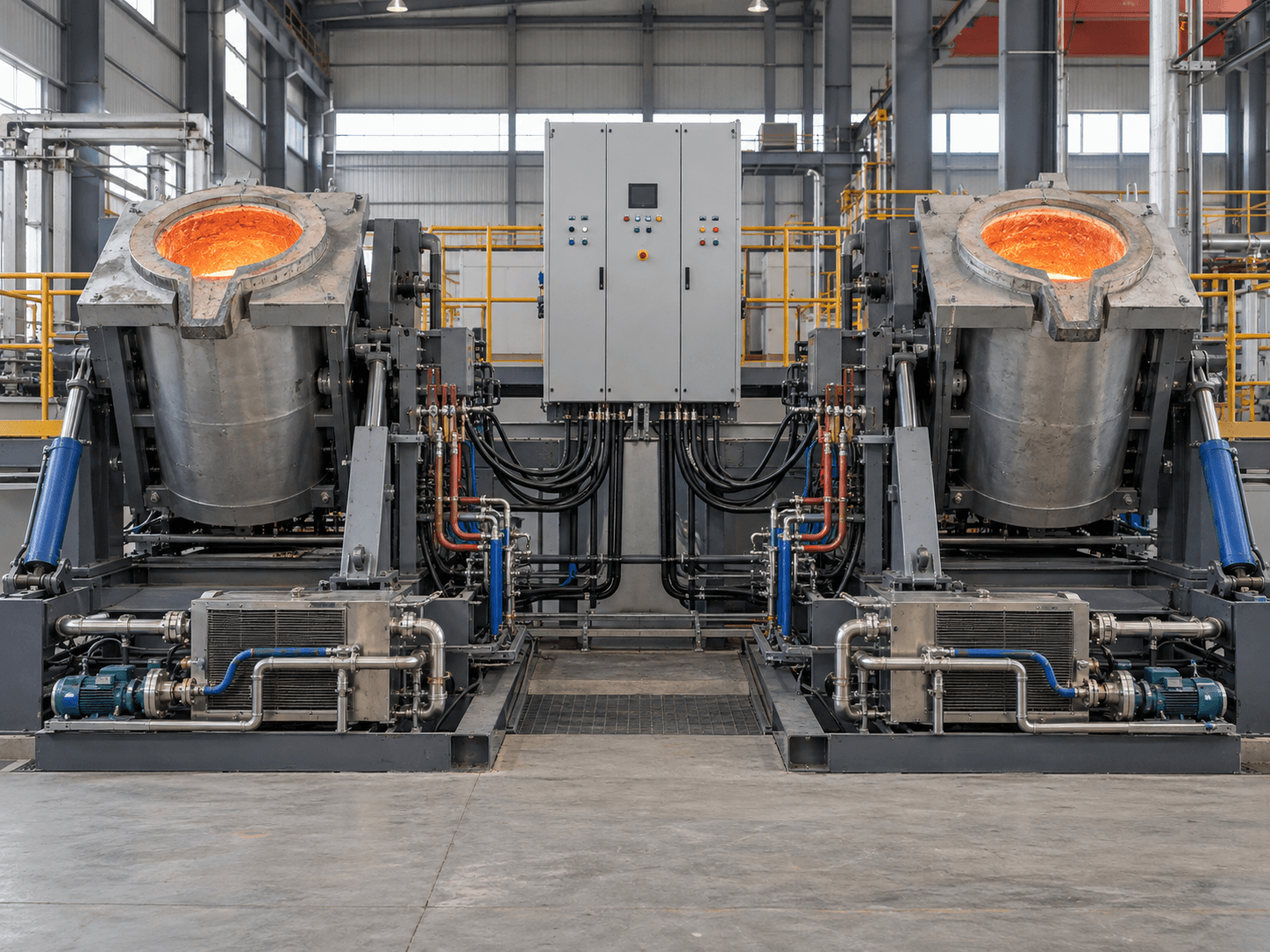
An induction furnace holds several tons of metal above 1,500 °C inside a copper coil carrying thousands of amps, cooled by water flowing a few millimetres away. The engineering that keeps those three things separate is what furnace safety is about.
This is an overview of the protection systems fitted as standard and the operating practice that has to sit alongside them. It supplements, and does not replace, the safety section of your equipment manual and your own site risk assessment.
Cooling water is the primary safety system
Coil cooling is not a performance feature; it is the thing preventing a coil failure with molten metal present. Flow and temperature are interlocked, so a loss of flow removes power before the coil is damaged.
The part buyers most often try to economise on is the emergency backup — a gravity-fed tank that keeps water moving through the coil after a power failure, when the pumps have stopped but the furnace is still full of hot metal. It is the cheapest item on the safety list and the one you cannot substitute with a procedure.
Why the cooling loop must be closed and deionised
Raw water deposits scale inside the coil tube. Flow falls gradually, the coil runs hotter, and eventually it fails — usually with no warning, because the flow switch is set for a sudden loss rather than a slow decline. A closed loop with deionised water in the internal circuit and a plate heat exchanger to the tower prevents the mechanism entirely.
Conductivity should be monitored, not assumed. A deioniser cartridge that has stopped working looks exactly like one that is working, right up until the coil is scaled.
Moisture in the charge
Charging wet or oily scrap onto a molten heel causes a steam explosion — water flashing to steam expands violently and ejects molten metal. It is the most frequent cause of serious injury around induction furnaces, and it is entirely a practice problem rather than an equipment one.
Scrap must be dry before charging. Closed vessels, sealed pipe sections and anything that could contain trapped liquid must be opened or excluded. Where the feedstock is unreliable, a preheating stage both dries the charge and improves melting efficiency, which makes it easier to justify than a pure safety cost.
The interlocks fitted as standard
Every system we supply includes the following. During commissioning we test each one in front of your maintenance team, and they should be re-tested on a documented schedule rather than assumed to work.
- Cooling water flow and temperature interlocks on the coil and power supply
- Coil earth-leakage detection — the earliest warning of lining wear through to the coil
- Water-leak detection in the furnace body
- Over-current, over-voltage and phase-loss protection
- Mechanical tilting lock that holds the furnace at any angle without hydraulic pressure
- Emergency hand pump to return the furnace upright without electrical power
- Emergency stop circuits at the console and at the pouring position
Practice the equipment cannot cover
Protective equipment for anyone within reach of a pour. A clear, dry pouring area with an emergency drain pit sized for the furnace contents. A defined lining change-out point that is respected rather than pushed. Restricted access during charging and pouring.
The last one is worth stating plainly: a lining run past its change-out point risks a coil breach with a full furnace. No production schedule justifies it, and any operation that finds itself repeatedly tempted needs a second furnace body rather than a stricter policy.